How we turn a 2,000-page textbook into a study guide
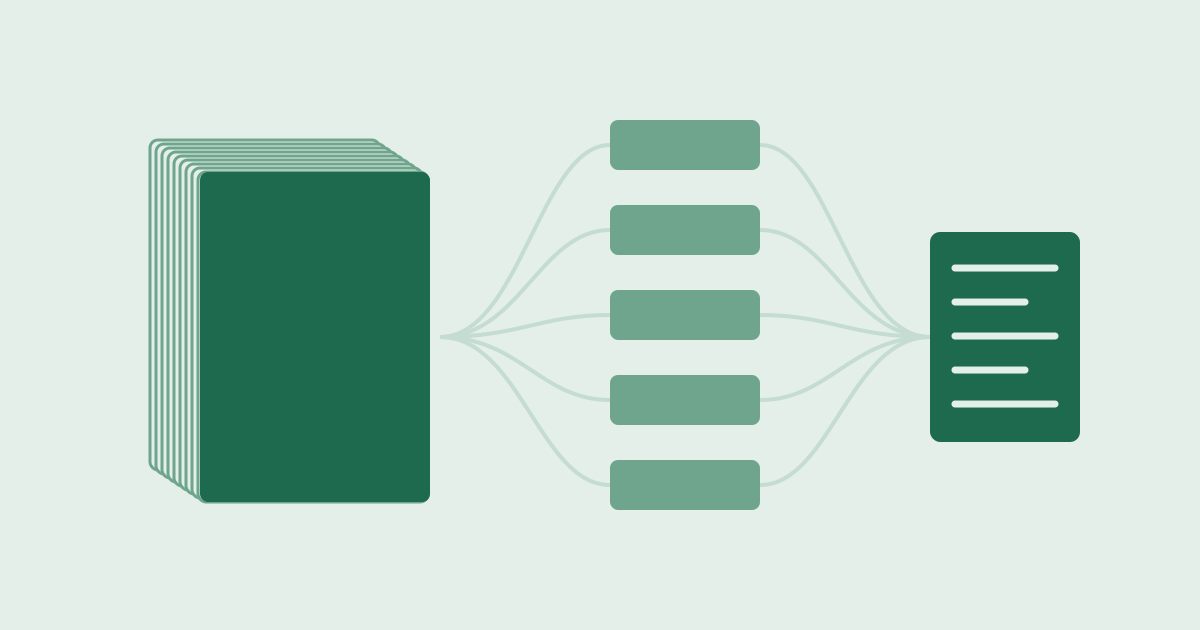
A 2,000-page textbook is about a million words, far more than an AI model can sensibly read and write about in one go. Here is how a shelf gets built from a book that size, why we split it the way we do, and why we don't simply hand the whole thing to a model with a giant memory.
Check the size before anything else
The page count is the very first check, made in your browser before the upload starts. We read only the PDF's page index, a few hundred kilobytes even for a 500 MB file. A file over 2,000 pages never leaves your computer, and it doesn't use one of your shelves for the month. The build checks again before it does anything else, in case the browser couldn't.
Cut what isn't taught
The build finds the chapters from the book's bookmarks, contents page and headings, and a model gives each one its real name. Then it sets aside everything that isn't subject matter: the preface, contents, index, bibliography, answer keys, and filler pages inside chapters, such as blank pages and "This page intentionally left blank". Study material covers the subject, never the book itself, so no one gets quizzed on the publisher or the edition.
Why not read it all at once?
Current models can take in a very long text, but taking it in isn't the same as covering it. In one test, models asked to summarise a large collection of documents scored below 20% on coverage without help, against about 56% for people (Summary of a Haystack, 2024). A study of book-length summaries also found they lean too heavily on the end of a book (FABLES, 2024). For a study guide, missing chapter 7 isn't a small flaw.
So the unit of work is the chapter. Every chapter gets its own careful reading, and every chapter counts equally.
Splitting at natural breaks
Most chapters fit in a single reading. A very long one is halved, and halved again, until each piece fits. Where it's cut matters:
- Best: at a heading or a new numbered section.
- Next: at the start of a definition or theorem, or a page break.
- Never: mid-sentence, between a theorem and its proof, or in the middle of a worked example or a list.
Pieces don't have to be equal. A clean break a little off-centre beats a messy one in the middle, so no idea is split in two. Concept lists are split the same way: a new part starts where a new topic starts, not between a definition and the misconception about it.
Many hands, then one voice
All the pieces, from every chapter, are worked on in parallel, and the results are put back together in page order. A chapter's study guide written in parts still reads as one section: only the first part opens it, and only the last part ends it with "Check yourself" questions. If an answer still runs too long, that piece is split again and redone straight away.
Each study-guide section is written from two things: the chapter's key concepts, and the book's own pages for those concepts. That way the explanations follow the book's notation and examples, in our own words.
The whole-book summary
For the summary and cheat sheet, we take the most important ideas from every chapter. For a very long book, groups of chapters are condensed first, then the summary is written from those. Researchers comparing approaches found this kind of step-by-step merging gives more coherent book summaries (BooookScore, 2024).
Why it takes 10 to 30 minutes
We send this work in batches, which costs half as much as asking for every answer immediately. That keeps the library free to use. A batch that runs long is cut off after 20 minutes and finished the fast way, so a build never stalls. We'll email you when your shelf is ready.
How this connects to our solution
- How it works, step 2: "Everything is built once." This is how the building works, for any book up to 2,000 pages.
- Belief 1: "A teacher's time belongs to students." The book is read once, carefully, so no one has to do it again.
- In the product: the progress page you see after an upload, and the chapter list on every shelf.
- Call to action: See how it works · Add a shelf