From library to growth hub: see what you know, and how to get where you want
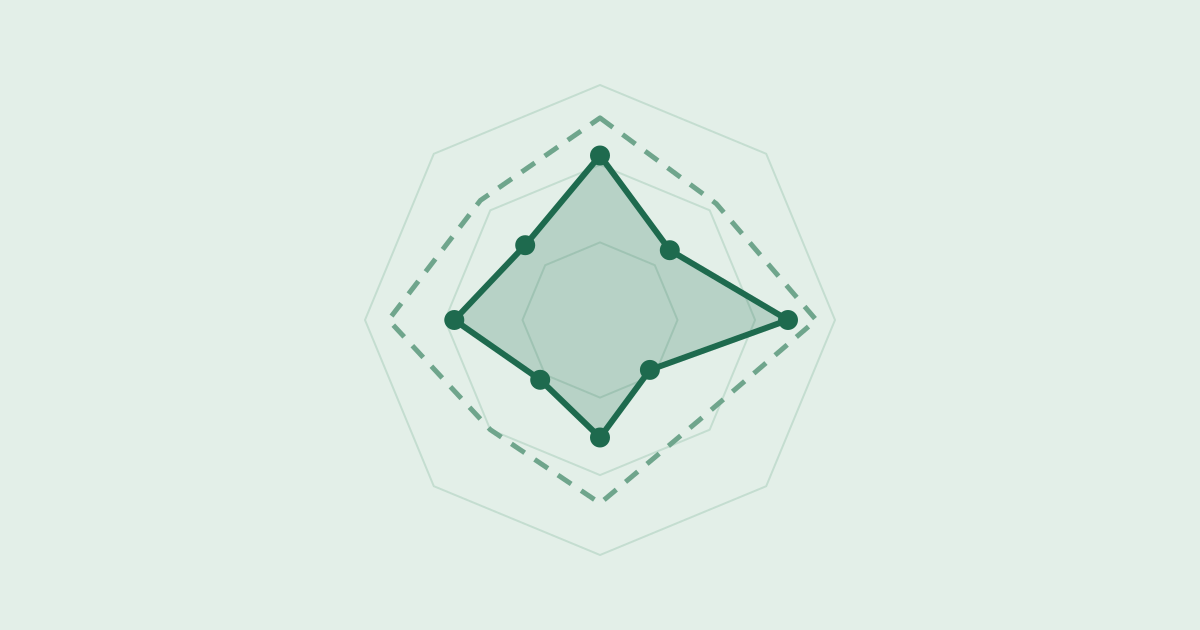
A library helps you learn a book. A growth hub helps you see where all those books are taking you. The Learning Library now does both: every learner gets an expertise web built from what they've mastered, and can lay a dream job or a college major over it to see the gap, and the shelves that close it.
The scale: how employers' job data describes knowledge
The US Department of Labor's O*NET database is "the nation's primary source of occupational information", covering over 900 occupations (O*NET). For each one, people working in the job rate 33 knowledge areas, from Mathematics and Chemistry to English, Law and Computers, on two scales: how important the area is (1 to 5) and the level needed (1 to 7). The level scale is anchored with examples; in maths, "add two numbers" is low and "derive a complex mathematical equation" is high (O*NET survey form).
We use the same 33 areas and the same 1–7 scale for learners, so "you" and "the job" are on one chart.
Your web comes from what you've mastered
Every shelf is tagged with the areas it teaches and the levels it takes you from and to; an algebra II book might take Mathematics from about 3.5 to 4.5. As you master its chapters in Learn, you move along that range. Your level in an area is the highest any shelf gives you. There are no self-ratings, and nothing counts for time spent: only chapters you've passed at 85%.
Jobs: how ready you are, and what to learn
Pick a job and the web overlays what it needs. You get:
- Readiness: the share of the knowledge the job relies on that you have, at the level it needs, weighted by how important each area is to that job.
- What to work on: the biggest gaps, most important first, each with shelves that teach the next step from where you are.
- Education: what people in the job say it requires, from O*NET's "required level of education" survey (for example, "62% say a bachelor's degree").
- Majors that lead there, from the US Department of Education's official crosswalk between college programs and occupations.
There's also a list of jobs that use what you know already, ranked by how closely they match your strongest areas.
Majors: the courses in between
Many jobs ask for a degree, so you can also overlay a major. No national database lists required courses (every college sets its own), so for each major we draft the courses most US bachelor's programs require, once, and label it as typical. Each course is mapped to the same areas and levels and linked to shelves in the library that teach it. Check your college's catalog for the real list.
Some honesty about job postings: degree requirements taken from live job ads exist only in paid datasets. O*NET's education data comes from surveys of people doing the job, which is a steadier guide to what the work needs. And employers are moving, slowly, toward skills: searching for people by skills rather than degrees widens the US talent pool almost 16-fold (LinkedIn, 2025), but fewer than 1 in 700 hires so far is actually made that way (Harvard / Burning Glass Institute, 2024). Knowing your skills and having the credential both matter.
Why this helps you learn
Seeing why schoolwork matters to your own goals can raise both interest and grades. When high-school students wrote about how science related to their lives, those who expected to do poorly gained interest and about two-thirds of a letter grade (Hulleman & Harackiewicz, 2009). The effects are uneven: they're largest for students who were struggling, and not every replication finds them. Goals also work best with feedback that shows progress toward them (Locke & Latham, 2002), which is what the web is: a goal, with your progress drawn on it.
Private by default
Your web and your dream job are yours. Teachers don't see them, and they're not public.
How this connects to our solution
- Belief 10: "Learning is a path, not a pile." The learning map shows the next book; the growth web shows where the path leads.
- Belief 9: "Measure what works for each learner; never label them." Your levels come only from what you've mastered.
- In the product: My growth in the main menu.
- Call to action: Open My growth · Find a shelf to start