Mastery, one chapter at a time
Most courses move on when the calendar says so. Mastery learning moves on when the student is ready: learn a unit, check it, fix what's shaky, and only then go on. Learn in The Learning Library works this way, one chapter at a time.
The idea
In 1984, Benjamin Bloom summarised a striking set of results. Students taught one-to-one by a tutor did about two standard deviations better than students in a regular class; the average tutored student beat 98% of the comparison class. Students taught with mastery learning, in ordinary classrooms, did about one standard deviation better, beating 84% (Bloom, 1984). Later effects have usually been smaller than Bloom's, but they hold up: a review of 108 controlled evaluations found positive effects on exam results, largest for the students who were furthest behind (Kulik, Kulik & Bangert-Drowns, 1990). The Education Endowment Foundation estimates about five months' extra progress over a year, at very low cost, though it rates the evidence as low in security (EEF).
Where we set the bar
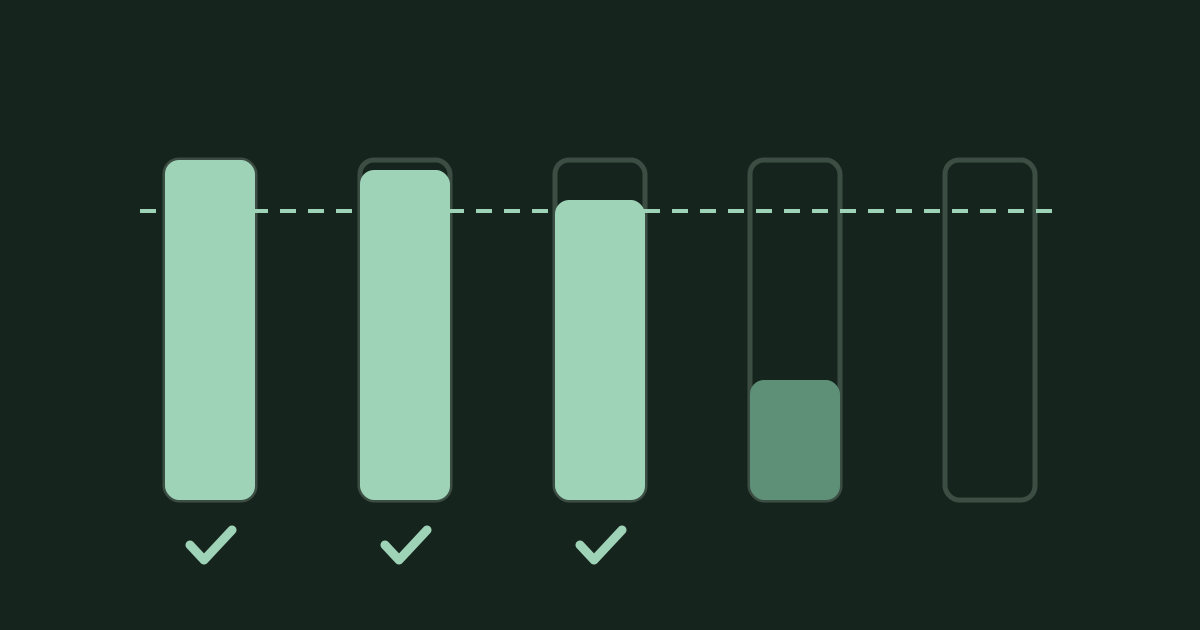
Mastery programmes usually set the bar at 80% to 90% on the unit test (EEF). We use 85%. Each chapter has a mastery check of fresh questions, and scoring 85% or more marks the chapter mastered and opens the next one.
What happens day to day
- Practice comes from your current chapter, the first one you haven't mastered. New ideas don't pile up on shaky ground.
- We tell you when you look ready. Once you're getting most of your practice right across most of the chapter, Learn suggests taking the check. You can take it any time.
- A miss shows you what to fix. Learn lists the ideas you missed, so you know where to look.
- You can always go back. Mastered chapters stay open for review, and short reviews from earlier chapters keep them from fading.
- Already know it? Take a later chapter's check early to test out of it.
When a chapter won't click
Sometimes more practice isn't the answer. If you fail a chapter's check twice, or score under 60%, Learn suggests another book that explains the same material differently, or one that covers the groundwork this chapter assumes. That comes from our learning map. Your progress here is kept.
How this connects to our solution
- Built on how people actually learn: this post is the evidence behind the card "Master one chapter, then the next".
- Belief 9: "Measure what works for each learner; never label them." Mastery is measured on fresh questions, not on time spent.
- In the product: the chapter path in Learn, mastery checks, and test-outs.
- Call to action: See the research we build on · Open Learn on any shelf